

The internet loves to flaunt strategies that offer higher returns without indicating the additional risk these strategies bring.
This week, I came across a post on X that really got me going. I see a lot of financial content on that platform. This one piece ended up circulating around and naturally, it was one of the options course “gurus” touting a put writing strategy.
They claimed that they are doubling the use of their funds and quietly bringing their annualized 10-11% returns to 25%.
Right away, I was irked. The strategy, a “portfolio-secured” put strategy, glossed right over the additional risk.
So, let’s walk through the strategy real quick. Remember, anything with options can be slightly higher level. Options can create additional risk and complexity when it comes to a portfolio.
This particular strategy revolves around using a portfolio to secure a written put option. When we write put options, we tend to be paid a premium. This premium is the reward for the obligation to purchase someone else’s shares in the event the underlying security trades at or below that value.
For a quick example, assume we sell a put option on ZZZ security, which trades at $50. The strike price we chose to sell is $40 and we were paid $2 for selling this put.
In the event ZZZ goes to $40 or below ($30, $20, etc.) we are obligated to purchase 100 shares for every contract we sold in the event of assignment.
It is set in stone that throughout the duration of the contract, we are obligated to purchase the shares if the shares reach that $40 level or lower.
(Many people do enjoy writing cash-secured puts. This is different from the strategy outlined above. For some, they would love to own ZZZ at $40, but maybe it isn’t there yet and is still at $50. They would essentially say, “I’d love to own these shares at $40, and I can make some premium while I wait to see if I can buy the shares with cash in the event they come down to $40.”)
But this is where the scenario I saw begins to deviate. The gentleman expressed that his puts are “portfolio-secured” not cash secured. Calling the puts portfolio-secured doesn’t eliminate any of the risks. Rather, it means that his portfolio is supporting the potential obligation created by the puts which is adding a layer of risk. On top of that, the risk is actually correlated.
This means that in the event he were assigned to purchase the shares of the puts he sold, he may have to liquidate a certain amount of his existing portfolio or deposit additional cash to purchase those shares.
Might sound good on paper, right? And I won’t even say this is not a viable strategy, I will, however, say that the gentleman egregiously understated the risks involved.
So, basically, here’s how this goes wrong. The market sells off significantly. The existing portfolio loses a lot of value, and all of a sudden, you’re on the hook to buy shares above the value they are currently trading at.
Essentially, the risk is correlated. As share prices decrease, the odds of being assigned the put also increase. The value of the put also increases, meaning to close out the put before the risk of assignment, the put may be more expensive than we sold it for. This is how the strategy adds risk to a portfolio.
Lots of pieces to the pie that can quickly work against us. Imagine watching a portfolio lose 50% of its value and then being on the hook to buy shares at $40 (although this is more like $38 when accounting for the $2 premium received) even though the underlying stock is trading at $20.
Here’s exactly how I would explain a strategy like this:
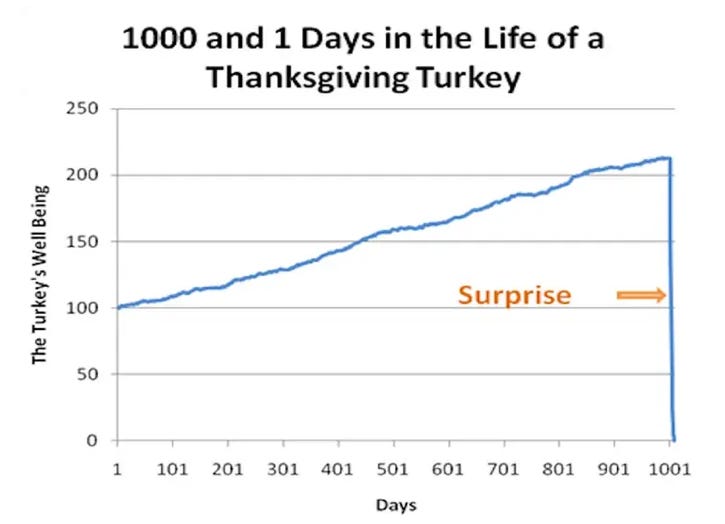
Now, again, this isn’t to say the strategy isn’t viable. It is to say that we must understand the additional risks.
Premiums from selling options don’t come from thin air. In the event of the written put, it is quite literally selling someone else insurance on their portfolio. They have transferred risk from themselves to you!
Be diligent out there. There is a ton of financial education online. Combing through this information to ensure you are getting qualified education is so important, especially when it comes to portfolio management.
I’d bet that if someone were able to attain 25% annualized returns on a consistent basis, they sure would not be selling a course on options trading. They’d likely be running billions of dollars at an institutional scale because everyone and their mother would be signing up to achieve those returns.
This is for informational purposes only and is not intended as legal, tax, or investment advice or a recommendation of any particular security or strategy. The investment strategy and themes discussed herein may be unsuitable for investors depending on their specific investment objectives and financial situation. Opinions expressed in this commentary reflect subjective judgments of the author based on conditions at the time of publication and are subject to change without notice. Past performance is not indicative of future results.