

I have the pleasure of working with young professionals. The best part of working with any young professional is that their potential is nearly unlimited.
That being said, it is not uncommon to see high achievers wanting more and more. Some people are saving and squirreling money away as the FIRE (financial independence, retire early) movement has encouraged people to save diligently at young ages.
But here’s the thing: You only get your youth once. So, I want to make the case for balance and give you an example of how money has a diminishing return as it pertains to our actual lives.
Here’s an example: Consider a 26 year old. They’ve saved diligently since they began their career and have amassed an investable net worth of $100,000.
They earn $120,000 per year and aim to save $30,000. 25% of their annual income, by many rules of thumb, this is an incredibly strong savings rate.
But they are always shooting to save more. Stretching themselves thin in an attempt to reach that 30% savings goal or $36,000 annually.
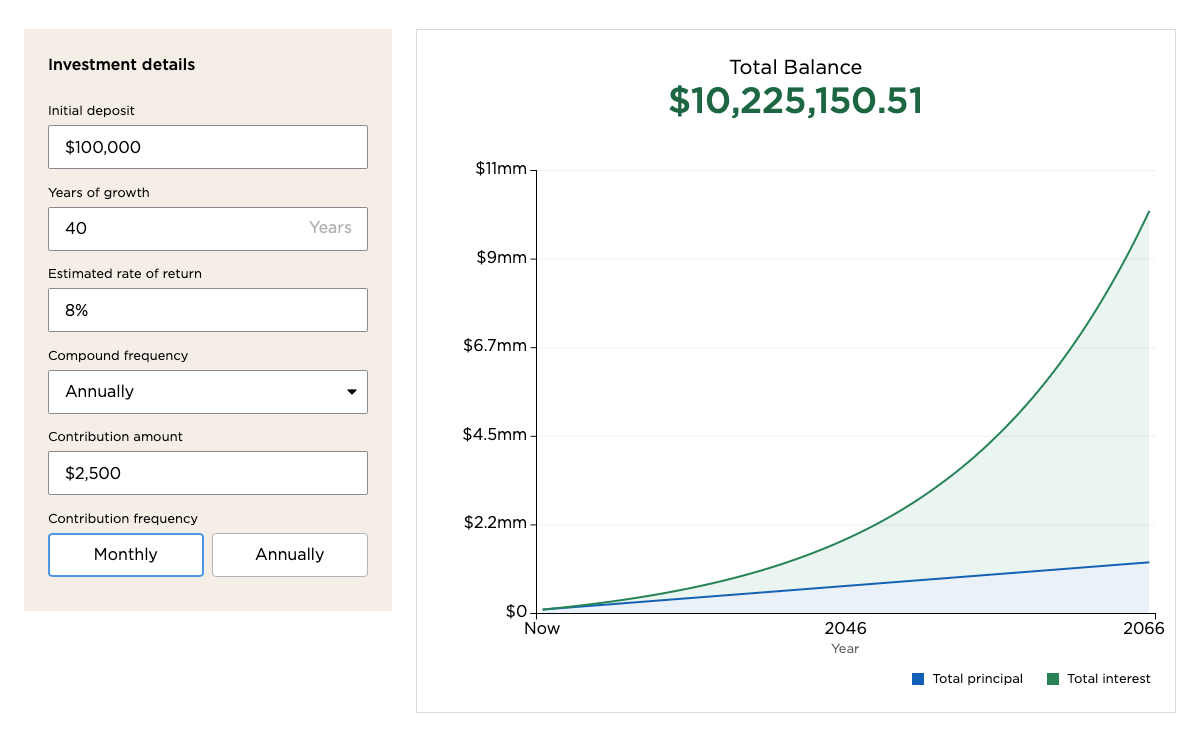
So, let’s take a look at some math. We’ll assume an 8% annualized rate of return and a 35-year time horizon. Of course, these figures are hypothetical. We never allow past performance to be indicative of future results.
Our friend who saved $30,000 per year ends with $10,225,000. Wow! That is a significant balance and they’re likely sailing off into the sunset of retirement feeling great.
But what about our friend that stretched themselves thin to save juuuuust a little bit more?
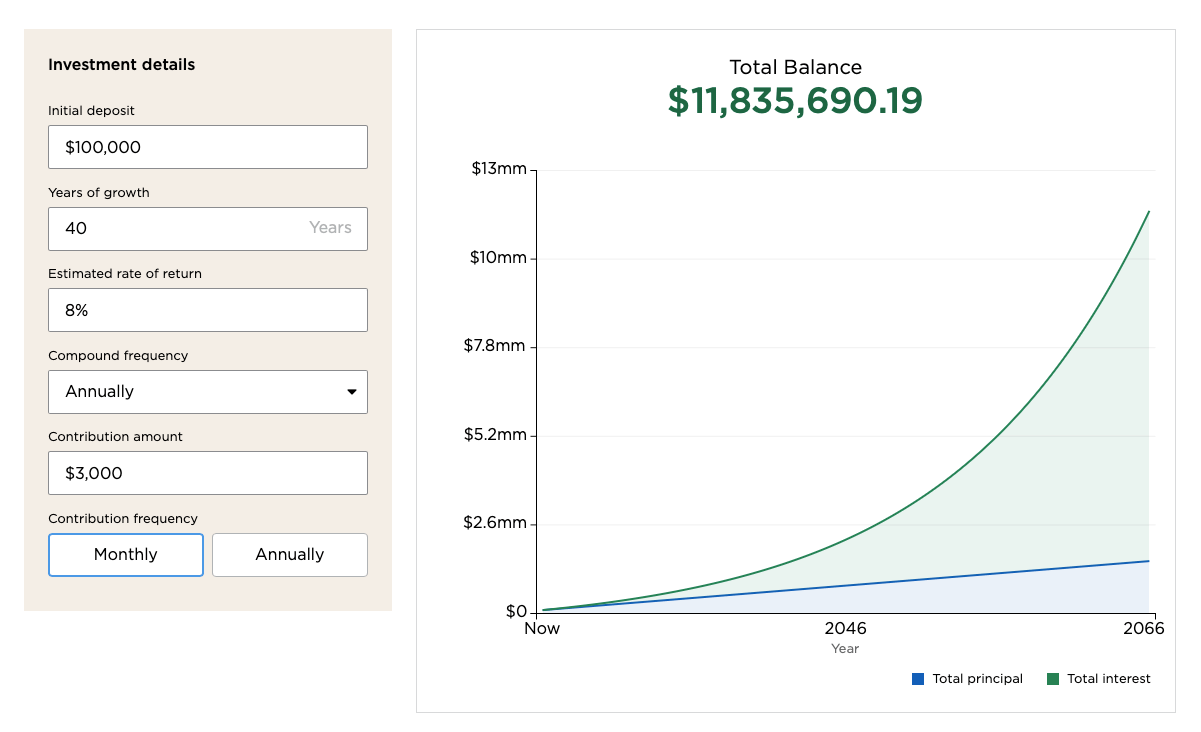
No surprise, they did significantly better. Their 66-year old self now has an extra $1,600,000 to spend during retirement.
But here’s the thing… As crazy as it sounds, $10M at retirement and $12M at retirement are nearly the same exact thing in my opinion.
That extra $2,000,000, as large as it seems, adds nearly nothing to the super saver’s life that the other saver couldn’t have themselves. And again, this is at age 66. The additional $2,000,000 is much less likely to move the needle for someone at that age.
But here’s where we need to take a moment. The individual who saved $6,000 less on an annual basis got to spend that. They got to spend it while they were young. Nights out, dinners, experiences, travel, etc.
$6,000 annually at age 26 might mean a world of difference. Someone might be able to live more comfortably and have significantly more experience than their super saver counterparts.
Speaking from my own experiences, I think that the $6,000 per year would serve me much better as a young person than the difference of $10M and $12M would serve me at age 66.
To round this up, when the foundation is put in place at a young age, additional sacrifice may not be needed to still end up “wealthy” at retirement. Everything is about balance but at the end of the day, money’s utility has a diminishing value.
I see many young savers that may feel anxious about their savings rate and begin stretching themselves very thin in order to put more away. Sometimes additional context around the potential future balances can allow someone to have a more balanced approach and enjoy their youth just a tad more.
Understanding how money can be used currently, how it can grow, and how it can compound for the future is my definition of respecting and valuing money. For some, it is hard to strike that balance, but balance is so important.
This is for informational purposes only and is not intended as legal, tax, or investment advice or a recommendation of any particular security or strategy. The investment strategy and themes discussed herein may be unsuitable for investors depending on their specific investment objectives and financial situation. Opinions expressed in this commentary reflect subjective judgments of the author based on conditions at the time of publication and are subject to change without notice. Past performance is not indicative of future results.