

Recently, Treasury came out with some potential scrutiny around tax-aware offerings across the industry.
Bloomberg added their own coverage on the topic. I’d argue their title was “clickbait-y.” The sub-title reads, “Cliff Asness’s AQR supercharged tax-loss harvesting, erasing IRS bills for the wealthiest.”
While some of the tactics are in regard to AQR’s specific offerings such as their tax-aware long-short strategies, which can generate significant losses, I think it’s important that we differentiate between tax-deferral and taxes being erased.
It is much easier to explain this using direct indexing as it is a long-only strategy. If you need a refresher on direct indexing, be sure to check out this article.
There is no better way to visualize what I mean when I say that direct indexing and harvesting losses is a deferral strategy than Brent Sullivan’s recent visual. Also, if you don’t follow Brent but want to know more about the world of tax-awareness, be sure to check out his website.
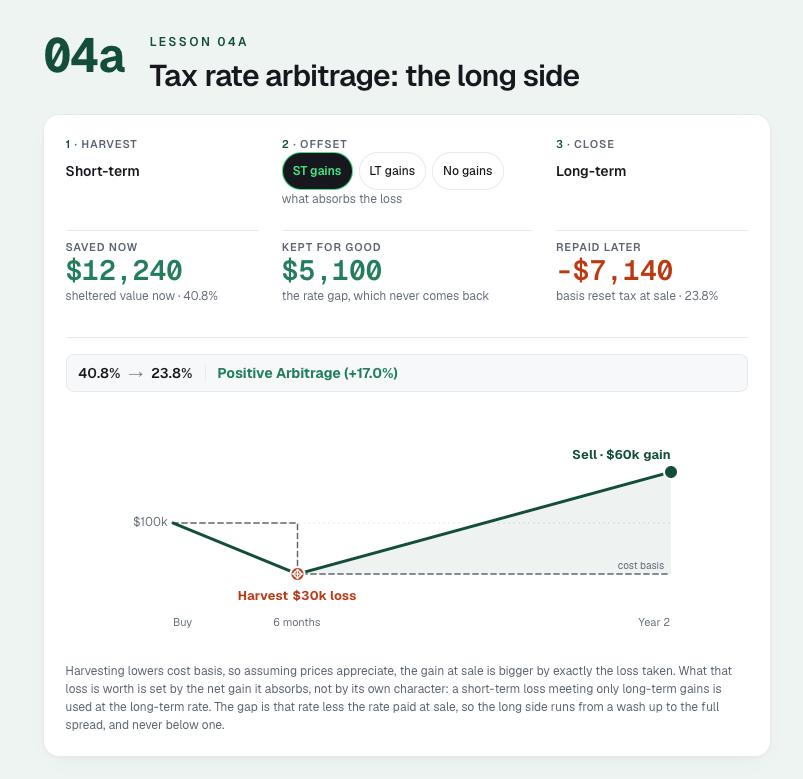
Before we unpack everything in the visual, I want to highlight something that many people overlook. Note the dotted line. It starts at $100,000 and upon the loss being realized, the basis is then reset to $70,000.
Stated simply, if we start with $100,000 and we realize a $30,000 loss, we only have $70,000 left over to create new basis with.
This is exactly why we’d consider it a deferral tactic. We now have a much lower basis than we would have. However, there is the potential for tax arbitrage. This is again, not “erasing” any gains. It is just opportunistically taking a loss to be used against a gain that’d be taxed at a higher rate (short-term capital gains) and then realizing a larger gain down the line at more favorable rates (long-term capital gains).
It is very similar to a pre-tax 401(k) contribution while someone is in a high bracket and looking to distribute the funds when income is lower in retirement!
Nonetheless, there are very few ways in which capital gains can be erased. They include death, charitable giving, and arguably Qualified Opportunity Funds. We won’t cover QOF today, but they can offer a combination of elimination and deferral.
So, at the end of the day, I think the Bloomberg article was a little aggressive and overlooked the idea of the basis resetting, which could lead to more gains down the line. A harvested loss may defer a tax bill, but that does not mean that the tax bill has been completely wiped away.
Executing the strategy properly could definitely result in tax arbitrage, but the gains are not erased, just deferred. This is what the idea of “tax-alpha” revolves around, not necessarily erasing capital gains entirely.
This material is for informational and educational purposes only and is not investment, tax, legal, or estate planning advice. Cryptocurrency and cryptocurrency-related investments involve significant risks, including volatility and possible loss of principal, and may not be suitable for all investors. An ETF may address certain considerations associated with direct cryptocurrency ownership but does not eliminate investment risk and involves its own risks, fees, and expenses. The transaction and outcome described were based on specific facts and circumstances and should not be considered representative of results that other investors may experience. Similar outcomes are not guaranteed and may not be replicated. The availability, costs, eligibility, and tax treatment of an in-kind transaction vary based on the transaction and individual circumstances. Investors should consult appropriate tax and legal professionals.
This is for informational purposes only and is not intended as legal, tax, or investment advice or a recommendation of any particular security or strategy. The investment strategy and themes discussed herein may be unsuitable for investors depending on their specific investment objectives and financial situation. Opinions expressed in this commentary reflect subjective judgments of the author based on conditions at the time of publication and are subject to change without notice. Past performance is not indicative of future results.