

When it comes to capital gains, some have a hard time understanding how they are actually taxed. If this is you, don’t worry. I have seen professionals get tripped up with this before!
I built this little visual to help everyone understand the nature of capital gains. For some, the “stacking” nature of these taxable events.
Essentially, capital gains are taxed at either 0%, 15%, or 20% federally. However, they are taxed at these rates according to taxable income, which capital gains are a part of.
Although they are taxed differently than ordinary earned income, they still count towards taxable income.
So check this out:
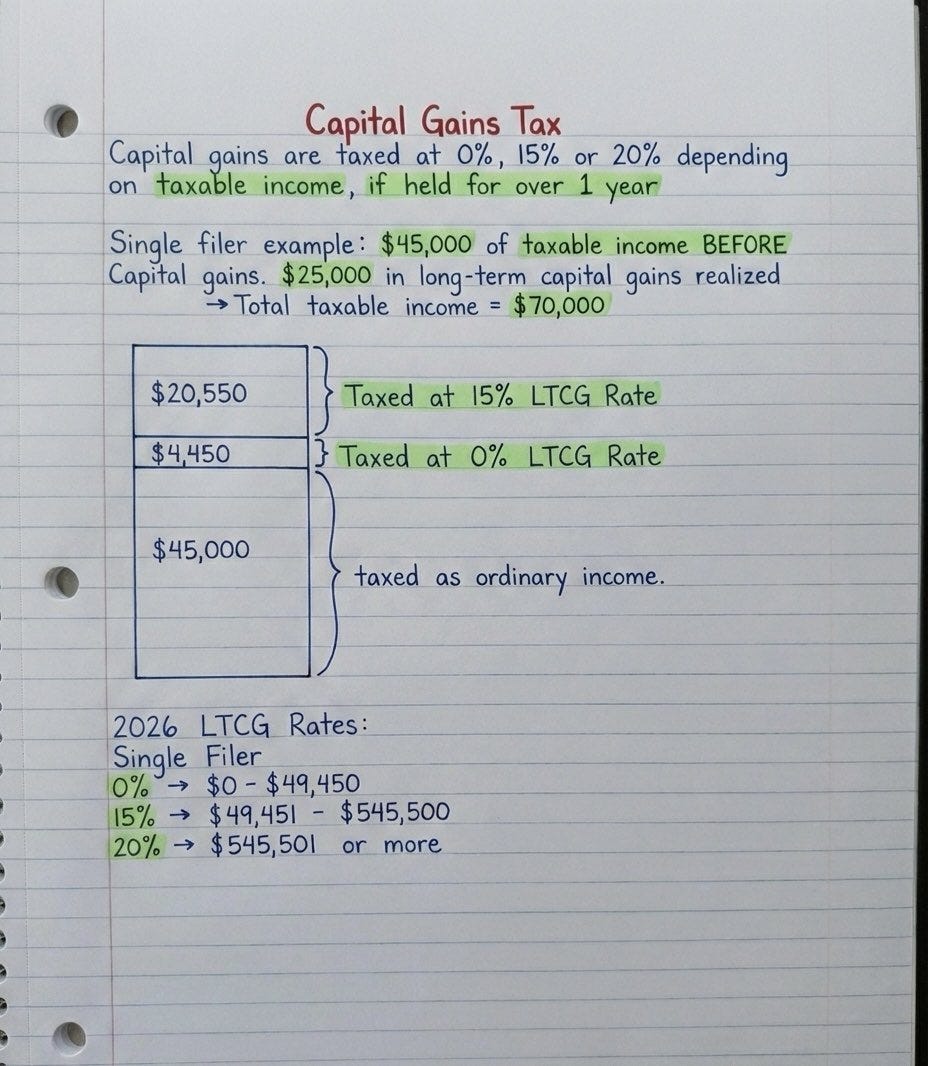
For a single filer who had taxable income of $45,000 before their capital gains and they realized $25,000 in capital gains, they now have taxable income of $70,000 for this year.
The first $45,000 of taxable income will be taxed as ordinary income. The capital gains then play by the long-term capital gains rates.
One of the biggest misconceptions is that the 0% bracket for LTCG applies only to capital gains no matter taxable income. This is untrue. The 0% bracket applies to capital gains that fall within that bracket after taxable income is considered.
You’ll notice that similarly to more traditional income tax brackets, capital gains rates are progressive.
The scenario above does a solid job of showing how $4,450 attains the 0% bracket, while the remainder is pushed into the 15% LTCG bracket.
I won’t even lie to you all, just a few years ago this stuff still tripped me up. But it is incredibly important.
To throw a wrench into all of this, when income exceeds a certain threshold, an additional net investment income tax can apply. This additional tax complicates things slightly, but we’ll cover that another time! It is definitely something to be aware of!
This is for informational purposes only and is not intended as legal, tax, or investment advice or a recommendation of any particular security or strategy. The investment strategy and themes discussed herein may be unsuitable for investors depending on their specific investment objectives and financial situation. Opinions expressed in this commentary reflect subjective judgments of the author based on conditions at the time of publication and are subject to change without notice. Past performance is not indicative of future results.